
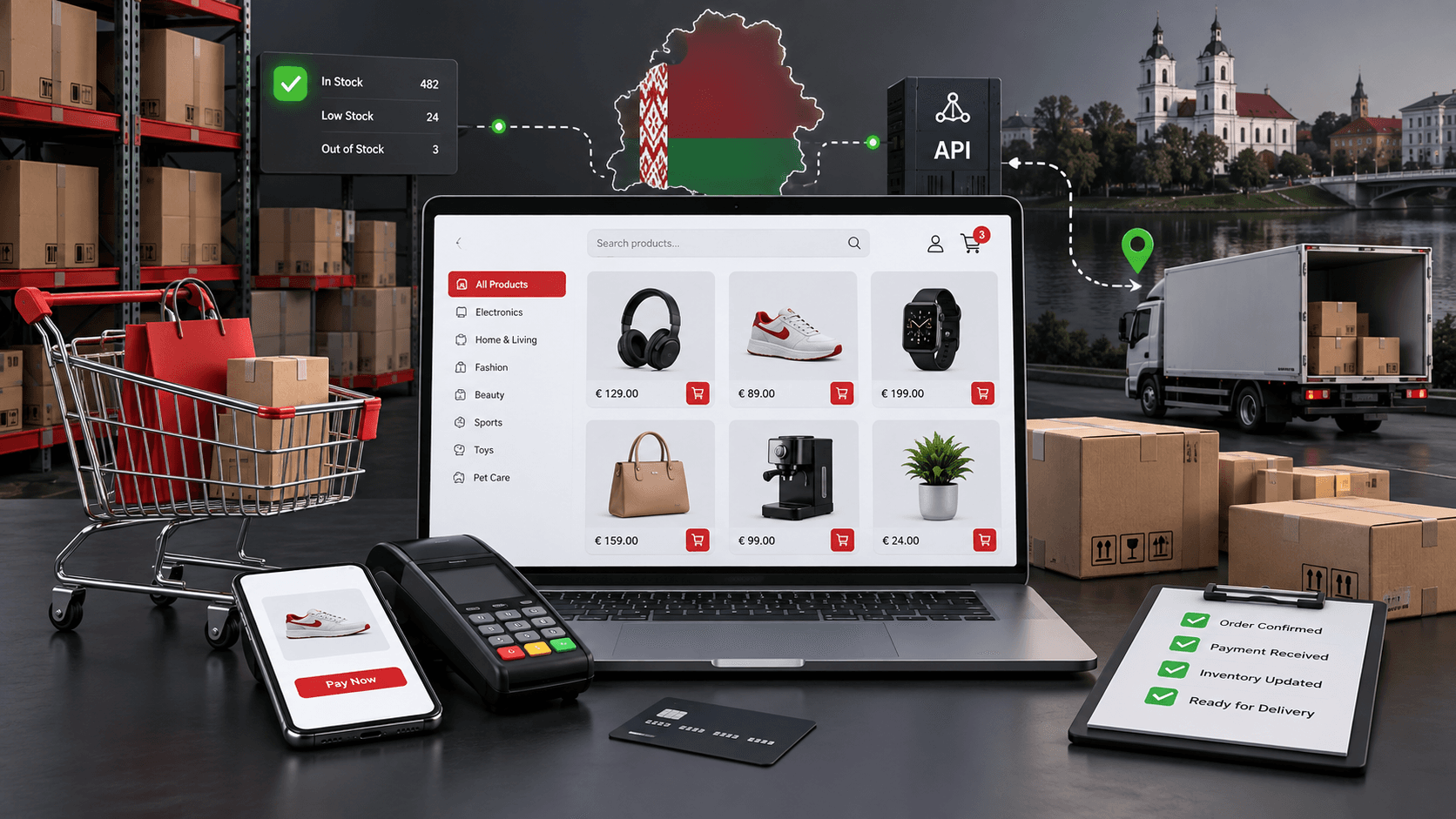
The short answer: basic online stores on the Belarusian market start at roughly 2000 BYN, custom solutions are often in the range of 5000–15000+ BYN, and projects with a large catalog, ERP/CRM/1C and custom logic can cost 15000–30000+ BYN.
These are open-market benchmarks, not fixed KBK TechLab prices. The cost of a specific store depends on the catalog, processes and integrations.
Why a store costs more than a regular website
An informational site mostly shows content and collects requests. An online store manages products, prices, stock, the cart, payment, delivery, order statuses and personal data. A mistake here affects not only the appearance but also money and accounting.
Even the familiar "Buy" button launches a chain: check availability, calculate the total and delivery, create the order, receive the payment status, reserve the item and notify the customer.
Development approaches
Ready-made CMS
Suitable for a standard catalog and a typical checkout. Launch is faster, and ready-made payment and delivery modules exist. It is important to evaluate the quality of the theme, its updates and plugin compatibility.
WooCommerce
A good option for a small or medium store, especially if the team already uses WordPress. With a lot of non-standard logic, plugins can start to conflict and complicate maintenance.
Custom development
Needed when processes cannot be fitted into a ready-made model: complex pricing, B2B roles, several warehouses, a special checkout or integrations. The budget is higher, but the architecture mirrors the business process.
Headless and custom frontend
A backend or commerce platform manages products, while a fast frontend is built separately. This gives interface flexibility and SEO, but adds an integration layer and requirements for the team.
Approximate market ranges
| Option | Benchmark | Suitable for |
|---|---|---|
| Basic store on a ready-made solution | from 2000 BYN | A small catalog, standard payment and delivery |
| Custom store | 5000–15000+ BYN | Unique design, integrations, user account |
| Complex commerce platform | 15000–30000+ BYN | A large catalog, ERP/1C, roles, non-standard logic |
The final cost is affected less by the number of product cards than by how they are loaded and updated. Ten thousand products with a clean import can be simpler than a hundred products with a dozen exceptions in accounting.
What the budget consists of
Catalog and product page
You need to define categories, attributes, variants, bundles, promotions and related products. For cosmetics, composition and recommendations matter; for electronics, comparison of parameters; for B2B, documents and different price types.
Filters and search
Filters must be fast and match the data. Errors in attributes make them useless. A large catalog may need a separate search engine, synonyms and typo correction.
Cart and checkout
Order placement affects conversion. The team designs the guest scenario, promo codes, total recalculation, payment errors and cart recovery. The more exceptions, the more tests.
Online payment
The integration includes creating a payment, a refund, a callback, signature verification and protection from duplicate processing. The available providers and requirements depend on the jurisdiction of the business.
Delivery
The cost depends on the address, weight, pickup point and the rules of the specific service. Sometimes fixed zones are enough; sometimes you need an API and status synchronization.
User account
A basic account shows the customer's orders and data. A B2B version may include organizations, employees, limits, contract prices, reorder and documents.
CRM, ERP, 1C and API
Integration connects online sales with the operational system. Products, customers, statuses, prices and warehouses need to be mapped. If accounting has no unified reference data, part of the budget will go into data normalization.
Stock and product import
The import must be repeatable and diagnosable: errors are visible, correct products are not duplicated, images are processed and changes can be reviewed. Manual upload suits only a small, stable catalog.
Catalog SEO
A store needs indexable product pages and categories, Product schema, canonical, sitemap and filter management. Endless parameter combinations must not create thousands of duplicates. Content and stock should be served to the search engine from the server.
Marketplaces
Marketplace integration can transfer products, prices, stock and orders. The possibilities depend on the available API and the seller account, so the scope is fixed after checking the documentation.
Admin panel
The editor needs clear operations: find an order, edit a product, run an import, check an error. Saving on the admin panel often turns into permanent manual work for employees.
Support
Commerce requires updates, payment monitoring, backups and a reaction to changes in external APIs. The cost of maintenance depends on criticality and the required SLA.
What makes an online store more expensive
- Several warehouses, currencies or legal entities.
- Individual prices and B2B roles.
- Complex bundles and configurators.
- A large unstructured catalog.
- Integrations without a stable API.
- Migration of orders and customers from an old system.
- High load and fault-tolerance requirements.
How to reduce the MVP budget
Start with the priority assortment, one payment method and clear delivery. Postpone the loyalty program, complex recommendations and several storefronts. Use a ready-made CMS if your processes really are standard, not just because it seems cheaper in the first month.
When a ready-made CMS is a normal choice
It suits you if the catalog is small, the checkout is typical, the integrations are covered by proven modules and the team agrees to work within the platform. This is a pragmatic choice, not a sign of low quality.
When you need custom development
Custom is justified when the store is part of the core product: B2B procurement, special pricing rules, several roles, non-standard logistics or deep ties with internal systems. Then trying to assemble the process from plugins becomes more expensive than a dedicated solution.
The page on online store development describes our approach. An example of a store with an AI consultant is the Semily case study. General ranges for websites are collected in a separate article.
FAQ
Can a store be launched without a user account?
Yes, for the first version a guest order and a status link are often enough. An account is added if repeat purchases and history really matter.
How long does development take?
A basic project usually starts at eight weeks. Integrations, migration and catalog preparation can extend the timeline.
Is filling the store with products included?
It depends on the contract. Usually the team configures the structure and the import, while the owner is responsible for the accuracy of attributes, prices and images.
Can SEO be transferred from the old store?
Yes. You need to keep valuable URLs or set up a map of 301 redirects, transfer metadata and check indexing after launch.
What matters more: design or integrations?
Both layers matter, but a store cannot work without reliable order and payment processing. With a limited budget, it is better to simplify the decoration, not the critical process.